
Adaptive PPPM2.0:
Risk Management

A Patent-Pending Leap Forward
Manage Risk Dependencies & Registers

digital-transformation

Risk Management


Prioritise high-impact risks
Project risk management in AdaptivePPPM2.0 goes beyond basic tracking, by integrating risk registers, risk dependency modeling, risk scoring and risk heat maps, directly into the project lifecycle, at the portfolio, program and project level. This enables proactive identification, visualisation and mitigation of risks that could impact timelines, budgets or deliverables. With colour-coded risk scores and the ability to map dependencies across projects and tasks (at the parent, child and grand-child level), project managers gain real-time visibility into exposure points, prioritise high-impact risks and maintain control - even in complex, multi-phase initiatives.

Scale Seamlessly
The system scales seamlessly from straightforward workflows to large, multi-phase initiatives. Its flexibility ensures that teams of any size or structure benefit from structured risk management, clear ownership and real-time visibility.

Unlimited Risk Registers and Entries
Create as many Risk Registers and risk entries as required. Each Risk Register also displays whether each risk has any dependencies and links to a visualisation of risk dependencies.

Creation
Risk Registers can only be created after projects, programs and portfolios have been approved, with at least some staff assigned, as each risk has an owner.


Supplier Risk Management


Direct Supplier Access
Suppliers can securely log and manage their own risks, without visibility into PM-level registers, ensuring data integrity and collaboration. Project Managers can also add and manage Supply Chain risks.

Transparency Strengthens Resilience
This closed-loop model fosters accountability, while protecting sensitive project data. By giving suppliers ownership of their risk profiles, teams gain earlier visibility into potential delays or compliance issues, improving responsiveness and trust. It creates a rare blend of openness and control — designed for simple or complex, distributed projects where transparency strengthens resilience.
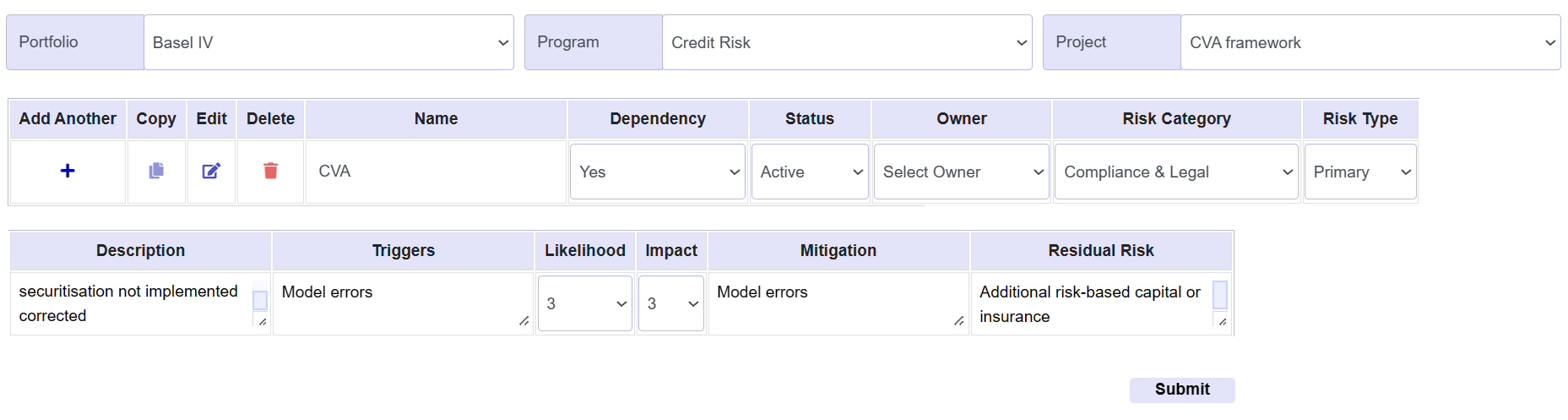


risk-register-create
Create Risk Registers
  • Create: Select the relevant portfolio, program or project, risk owner, risk category, enter risk description, triggers, likelihood, impact, risk mitigation and residual risk. The system calculates risk scores. The copy button lets you copy an entire row, to edit and create new risks more quickly. You can also edit and delete risks, subject to permissions. Optionally "save as PDF"


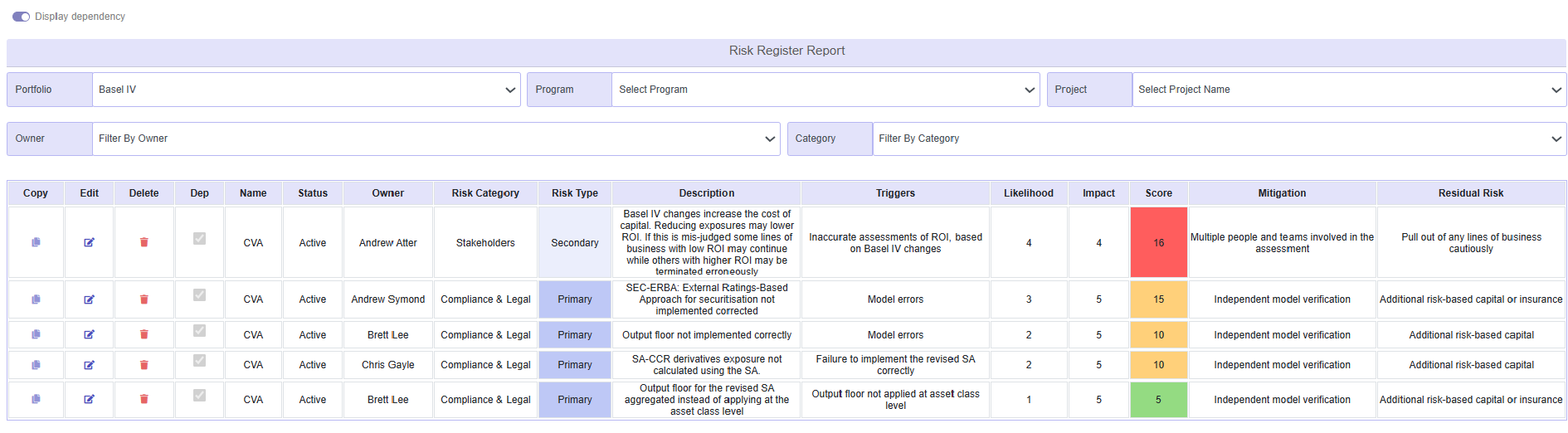
Risk Register Report
  • Portfolio, Program & Project Risks: View detailed breakdowns: Risk Type, the portfolio, program or project, risk owner, risk category, description, triggers, likelihood, impact and score, risk mitigation, as well as residual risk. Filter by portfolio, program or project; by owner or category. Filtering by category allows specialists to focus on risks within their remit. A toggle lets users display whether each risk has dependencies

risk-register-report


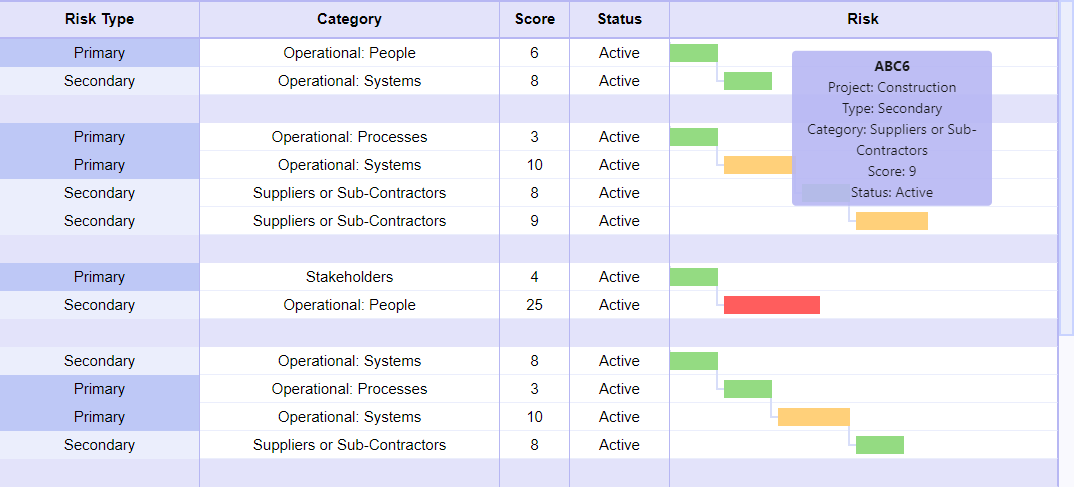
risk-dependencies
Risk Dependencies
  • Select Risk Pairs: Select any two risks with a dependency from any portfolio, program or project risk register. Considering risks at the portfolio level may rationalise overall risk management

  • Summary Data: At a glance view key data, such as: Risk type, category, score and status. Rectangles display RAG colour-coding of high-medium-low risk. Hover over any rectangle to see which project/program or portfolio is being referenced


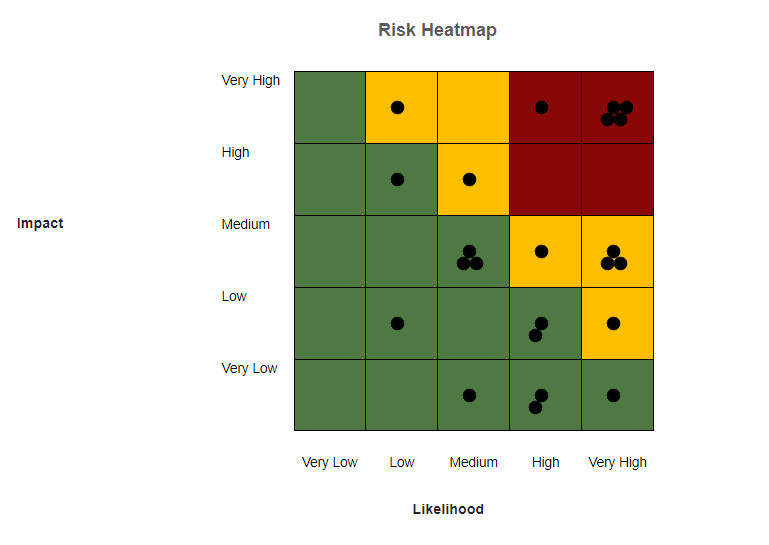
Risk Heat Map
  • RAG: The well-known Red-Amber-Green (RAG) colour-coding is used to represent high, medium and low risk

  • Risk Scores: Risk scores are based on values from the relevant risk register, taking into account the likelihood and impact of each risk

  • Enterprise-Wide Risk: Risk heat maps are available at the portfolio, program and project level. They are suitable for use by Risk Managers or the PMO
risk-heat-map

Return to Project Menu


Request a demo or consultation